
The CoAEMSP believes in collaboration with state EMS offices and has developed resources to foster our shared goals: to produce high-quality education, competent clinicians, and better patient outcomes.
State Offices of EMS:
Sign up for CoAEMSP updates!
Get news from CoAEMSP in your inbox.
Sign up- Stronger Together: How State EMS Offices and Accreditation Partnerships Build the EMS Workforce
- FAQs Regarding State Offices of EMS and CoAEMSP
Roles and Authority of State Regulatory Agencies
What is the role of state/jurisdiction officials in the accreditation process?
Authority to conduct EMS education rests with a designated agency within each state or jurisdiction. As a result, only programs that have received appropriate state or jurisdictional approval to operate are eligible to pursue CAAHEP accreditation.
Once programs have received a Letter of Review (LoR) or accreditation, they must maintain continuous authorization from their state/jurisdictional EMS authority throughout the accreditation period. Loss of required state approval may affect a program’s accreditation status.
In addition, ongoing collaboration between CoAEMSP and state EMS offices helps ensure that accreditation standards remain relevant and supportive of developing a skilled EMS workforce.
Should a representative from the state/jurisdiction attend the site visit?
Although there is no CoAEMSP requirement for state/jurisdiction EMS office representation at site visits, EMS offices are always informed of upcoming visits and strongly encouraged to participate. The input and information that officials provide can greatly enhance the quality and depth of the visit.
State/jurisdictional EMS staff are welcome to contact CoAEMSP at any time for additional information regarding the site visit process.
What role does a state/jurisdiction representative play in a site visit?
CoAEMSP invites and strongly encourages state/jurisdictional EMS office representatives to attend program meetings, interviews, and other scheduled site visit activities. These representatives provide an important regulatory and workforce perspective that can enhance the overall quality, context, and depth of the review. Their participation helps promote alignment between accreditation expectations and state approval requirements, supports real-time clarification of regulatory questions, and strengthens communication among the program, the state EMS office, and CoAEMSP.
While state representatives provide valuable context and perspective, accreditation findings and recommendations remain the responsibility of the site visit team and the CoAEMSP review process.
Why should state officials attend site visits?
Participation by state officials provides direct insight into program operations, educational delivery models, resource allocation, and emerging trends in EMS education. Attending site visits can help them better understand how programs implement standards in practice, identify potential areas of risk or innovation, and support more informed decision-making related to state approval, workforce planning, and system development.
In addition, site visit participation helps build stronger collaborative relationships and shared understanding between accreditation and regulatory partners, ultimately supporting the common goal of preparing competent EMS clinicians.
Can a state/jurisdiction official conduct a simultaneous site visit during a CoAEMSP site visit?
Yes. State/jurisdictional EMS officials may choose to conduct a state-level program evaluation or review at the same time as a CoAEMSP site visit.
While the processes and outcomes are separate and independent, there is often overlap in the types of information reviewed. Coordinating visits can reduce duplication of effort for the program and allow both accreditation and regulatory representatives to gain a more comprehensive understanding of program operations.
It is important to note that accreditation findings and recommendations are made independently of any state/jurisdictional review outcomes, and state actions or decisions are likewise determined by the appropriate regulatory authority.
What happens if a state/jurisdiction representative finds a non-compliance issue that is not a CAAHEP standard?
CoAEMSP site visits are conducted to evaluate program compliance with the CAAHEP Standards and Guidelines. State/jurisdictional EMS education requirements may differ in certain areas to reflect local laws, regulations, or workforce needs.
If a state/jurisdiction representative identifies a deficiency that is specific to state requirements and not related to a CAAHEP Standard, the matter is addressed separately between the program and the appropriate state/jurisdictional EMS authority. The outcomes of state-level reviews are independent from CoAEMSP accreditation findings and recommendations.
However, if a state-level deficiency results in a change to a program’s authorization or approval to operate, this may have implications for the program’s accreditation status, as programs must maintain required state/jurisdictional approval throughout the accreditation period.
Can the state/jurisdiction representative communicate with the site visit team?
Yes. Open and professional communication among all site visit participants is important to a successful and productive review. State/jurisdictional representatives are welcome to engage in appropriate dialogue with the site visit team during scheduled meetings and activities.
CoAEMSP coordinates site visit logistics and can provide officials with schedules, participation details, and appropriate points of contact prior to the visit. Maintaining clear communication pathways helps ensure alignment, promotes shared understanding, and supports an efficient and collaborative site visit process.
Will the state/jurisdiction representative receive findings from the site visit?
CoAEMSP works collaboratively with state/jurisdictional EMS authorities to support timely and transparent communication. However, site visit findings and recommendations are considered confidential until formal accreditation actions are taken by the CAAHEP Board of Directors and publicly released.
If an accreditation action results in a change to a program’s accreditation status, CoAEMSP will communicate this information directly to the appropriate state/jurisdictional EMS authority in a timely manner.
This approach helps preserve the integrity of the accreditation process while ensuring that regulatory partners are informed of final outcomes that may impact program approval or operation.
Can CoAEMSP shut down a program for non-compliance with CAAHEP Standards?
No. CoAEMSP does not have the authority to “shut down” an educational program.
CoAEMSP serves as the Committee on Accreditation, responsible for reviewing programs for compliance with the CAAHEP Standards and making accreditation recommendations. The final accreditation decision – including probation, withholding accreditation, or withdrawing accreditation – is made by CAAHEP.
If accreditation is withheld or withdrawn due to non-compliance, a program may still choose to continue operating. However, it would no longer hold CAAHEP accreditation, which can have significant implications related to student eligibility for certification, state approval, institutional policy, and employer expectations.
Throughout the process, CoAEMSP works collaboratively with programs to identify areas of non-compliance, provide guidance, and support continuous improvement with the goal of helping programs achieve and maintain accreditation.
Can CoAEMSP shut down a program for non-compliance with State rules and regulations?
No. CoAEMSP does not have the authority over state rules or regulations. Oversight and enforcement of state requirements fall under the jurisdiction of the state EMS office, licensing board, or other appropriate state regulatory authority.
However, programs are expected to maintain compliance with all applicable state approvals, authorizations, and regulatory requirements as a condition of operating and, in many cases, as a component of maintaining accreditation.
If a program loses required state approval or is found to be out of compliance with state regulations, this may have implications for its accreditation status. In such situations, CoAEMSP will work with the program to understand the issue and determine appropriate next steps within the accreditation framework.
What are the due process options for a program found to be non-compliant?
Programs identified as being non-compliant with the CAAHEP Standards and Guidelines are afforded multiple due process opportunities throughout the accreditation review process.
These may include the opportunity to submit additional information or evidence, provide a written response or rebuttal to findings, participate in dialogue with CoAEMSP staff, and, when applicable, request reconsideration or appeal of an accreditation recommendation or final accreditation action in accordance with established CAAHEP policies, or CoAEMSP policies in the case of an LoR program.
The accreditation process is designed to be transparent, consistent, and supportive of continuous improvement, allowing programs reasonable time to address areas of concern and demonstrate compliance before final decisions are rendered. Programs are encouraged to communicate early and often with CoAEMSP to ensure they understand expectations, timelines, and available options throughout the process.
What if there is a conflict between state statute/regulation and CoAEMSP policies or CAAHEP Standards and policies?
Though rare, this does occur, and the key is for programs to satisfy both state and accreditation requirements. When one is less restrictive than the other, the more restrictive requirement must be met.
Logistics
What is the typical timeline to receive a CAAHEP decision after a site visit?
The timeline can vary depending on several factors, including the complexity of findings, the program’s response timelines, and the scheduling of CoAEMSP and CAAHEP review cycles.
In many cases, programs may receive a final decision within several months of the site visit. However, when additional information, progress reports, or due process steps are required, the full process can take up to one year from the date of the site visit to final CAAHEP action.
Programs are encouraged to respond promptly to requests for information and maintain communication with CoAEMSP throughout the process to help support an efficient review timeline.
Where do site visitors come from? What if there is a known conflict?
CoAEMSP site visitors are experienced EMS educators, medical directors, and subject matter experts who are recruited from programs, clinical agencies, and EMS systems across the country. Site visitors complete required training and serve as peer reviewers, bringing practical knowledge of program operations, accreditation expectations, and educational best practices.
CoAEMSP takes conflict of interest and objectivity very seriously. Prior to assignment, potential site visitors are screened for known or perceived conflicts, such as current or recent employment relationships, consulting roles, personal relationships, or competitive program affiliations.
Programs are also given the opportunity to review the proposed site visit team and identify any known conflicts or concerns. If a conflict is identified, CoAEMSP will evaluate the concern and, when appropriate, assign a different site visitor to ensure a fair, impartial, and credible review process.
General
Is CoAEMSP a regulatory agency? Is CAAHEP? Is CHEA?
No, CoAEMSP is not a governmental regulatory agency. It is a non-profit, non-governmental, peer-driven organization. CoAEMSP provides accreditation services for paramedic and AEMT education programs on behalf of CAAHEP.
CAAHEP is not a governmental agency. It is a programmatic postsecondary accrediting agency recognized by the Council for Higher Education Accreditation. CAAHEP carries out its accrediting activities in cooperation with 25 review Committees on Accreditation in the health sciences professions.
CHEA is also not a governmental agency. It is a non-profit organization established in 1996 by university and college presidents to coordinate accreditation and ensure academic quality. While it works alongside the U.S. Department of Education, CHEA is a non-governmental organization. In essence, CHEA “accredits the accreditors.”
How does accreditation benefit the public?
Accreditation promotes quality, consistency, and accountability in EMS education, helping ensure that graduates are competent and prepared to provide safe and effective patient care. By establishing national standards for program resources, curriculum, clinical experiences, and outcomes, accreditation supports the development of a well-trained EMS workforce.
Along with certification and licensure, accreditation serves as an important public protection mechanism by helping ensure that EMS clinicians entering the workforce have received education that meets recognized professional standards. This contributes to improved patient outcomes, stronger EMS systems, and greater public confidence in the care they receive.
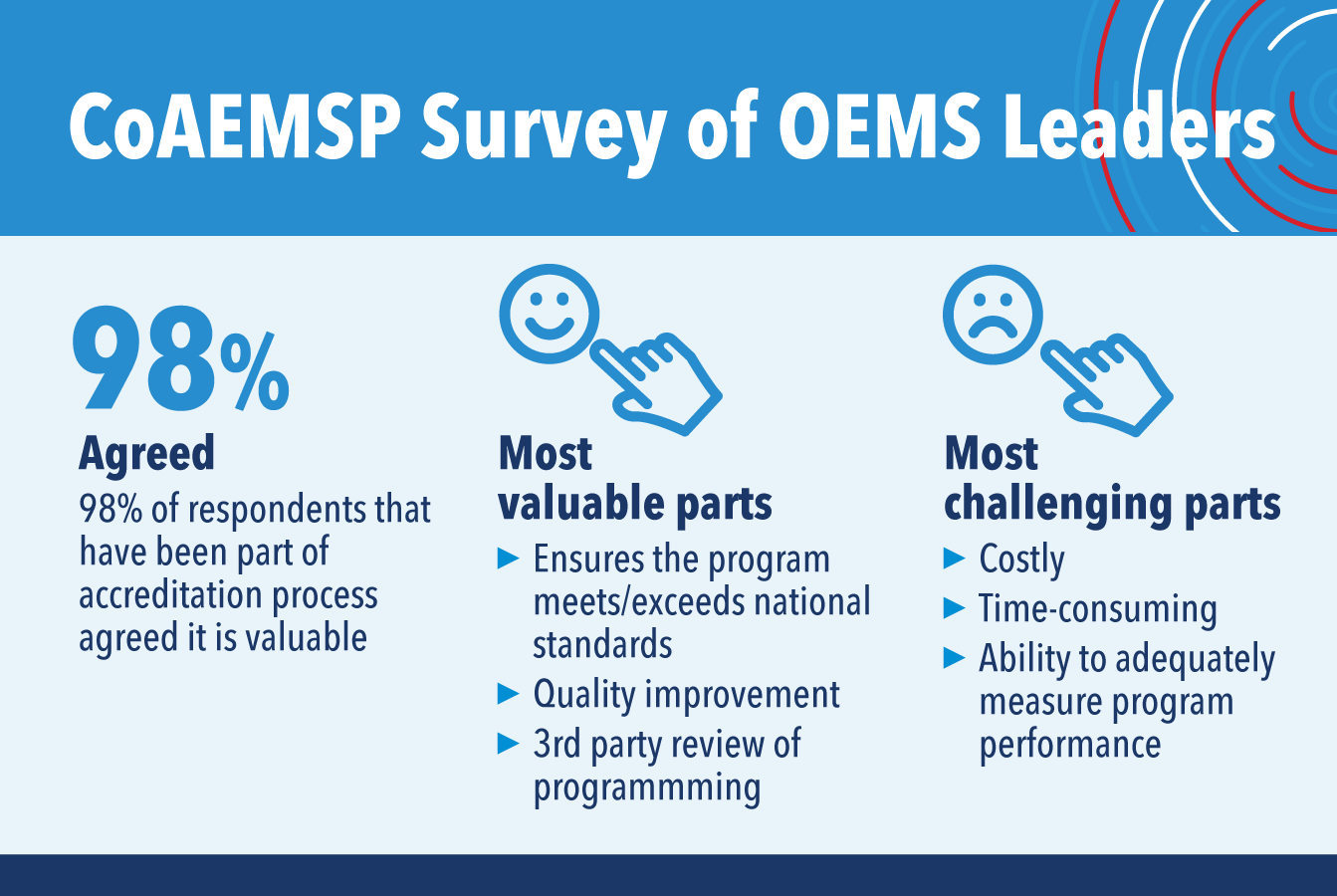
- Highlights from Office of EMS Survey
Key Resources for State Offices of EMS
CAAHEP Standards & Guidelines 2023 (effective on January 1, 2024)
CoAEMSP Interpretations of the CAAHEP Standards and Guidelines (2023)
CoAEMSP Policies & Procedures Manual
Site Visit Report (blank) – 2023 CAAHEP Standards
Talking Points & Conversational Starters
State officials seeking additional information are encouraged to contact J.C. Cook or Randy Kuykendall – contact information available here.