Category Archives: Archived Webinars

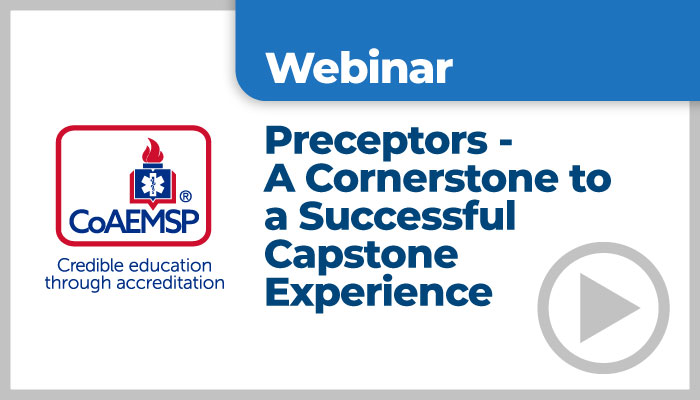
Preceptors – A Cornerstone to a Successful Capstone Experience


September, 2022

Kim McKenna
Rick Ellis
Jeff McDonald
Megan Corry

It is widely acknowledged that the capstone field experience represents the synthesis of all learning in a paramedic program. This phase of the program is critical to assess the paramedic student’s ability to integrate all elements of learning gained in the classroom, lab, clinical, and field experience. During the capstone field internship, the student must successfully team lead with minimal prompting and be provided accurate, honest feedback by expert field preceptors. The selection, training, and ongoing feedback between the program staff and capstone field internship preceptors is essential to assure that the student is progressing appropriately and to intervene with remediation measures when communication between program staff and preceptors indicates that the learner is not reaching entry-level practice as a paramedic.

This panel discussion explores these issues and provide guidance on how to design an effective capstone experience to maximize the student’s success at this most critical phase of their program.

  • Describe the goals of the capstone experience.
  • Determine selection criterion for capstone preceptors.
  • Outline strategies to assure the capstone preceptor(s) know their expectations.
  • Explain effective approaches capstone preceptors may use to provide feedback to students.
  • Discuss the techniques to monitor student progress during the capstone experience.
  • Identify measures to remediate learners who are struggling during the capstone experience.
  • Locate resources on the CoAEMSP website with information related to the capstone experience.
Clinical Coordination


Recorded on August 17, 2022

Facilitated by:
Pat Tritt

Student experiences in the clinical and EMS field environments are essential to developing critical thinking skills and the application of the theory and practice components of any Paramedic program. Program faculty play a key role in identifying appropriate partners for those rotations, scheduling students, and most importantly, guiding the students as they develop the necessary assessment and management skills. Communication and observation of students during this experience and communication with preceptors are keys to developing and assessing competency.

At the conclusion of this presentation, participants were able to:

  • Discuss sequencing options of clinical and field assignments.
  • Identify challenges in selecting the best sites and preceptors to facilitate the student experience.
  • Describe the role of the Clinical Coordinator.

Resources

Document LinkDateType
Slides: Clinical CoordinationJun 2022pdf


Strategic Planning: Best Practice for Every Program


Recorded on June 8, 2022

Facilitated by:
Megan Corry and Lori Burns

Program directors are responsible for the continuous quality review, improvement, long range planning, and ongoing development of the accredited paramedic program (Standard III.B.1.a.). This is achieved through a strategic planning process involving the program sponsor, personnel, students, and advisory committee members. This webinar will discuss the best practices of accredited programs in the process of strategic planning and ongoing program improvement.

At the conclusion of this presentation, the participant will be able to:

  • Describe the tools used to evaluate program resources and outcomes in accredited paramedic programs.
  • Integrate data from the resource assessments and outcomes surveys into the long-term planning process.
  • Examine the roles of the students, graduates, program personnel, sponsor, and advisory committee in the strategic planning process.

Resources

Document LinkDateType
Slides: Strategic Planning Best PracticesJun 2022pdf

Retention

Recorded on April 6

Facilitated by:
Michael Miller, EdD, RN, NRP, Assistant Director
Patricia Tritt, MA, RN, Technical Consultant

Education programs across the country are being held accountable for program outcomes, typically including passing rates on credentialing examinations, placement of graduates, and attrition/retention of students. Of these three outcomes, retention tends to be the most challenging for programs. The reasons students leave are varied and include academic, financial, personal, and pursuing other career opportunities. This session will explore the outcome threshold metric, how it is established, why retention is important and approaches to increasing retention in Paramedic programs.

At the conclusion of this presentation, the participant will be able to:

  • Discuss the rationale for the CoAEMSP retention threshold.
  • Discuss why retention is an important metric in higher education.
  • Describe strategies to retain students in the Paramedic program.

Resources

Document LinkDateType
Slides: RetentionApr 2022pdf

Simulation

Recorded on December 2, 2021

Dennis Edgerly, BS, EMT-P, and Patricia Tritt, MA, RN

In this conversational style presentation, Pat and Dennis discusses the technique of simulation. Effective use of simulation is discussed both in the context of design and implementation. Topics include placement of simulation within the curriculum, the efficacy of simulation for student evaluation, and the importance of debriefing. Simulation has become a key piece in medical education, at all levels, and has the potential to expand student opportunities far beyond what educational programs have been able to offer in the past.

Resources

Document LinkDateType
Slides: SimulationDec 2021pdf

Affective Domain Expectations

Recorded on October 7, 2021

Megan Corry, EdD, NRP, and Patricia Tritt, MA, RN

Join Megan and Pat to learn to:

  • Define affective competency and importance in healthcare and preparation of prelicensure providers
  • Identify areas of the CAAHEP Standards and CoAEMSP interpretations of the standards where affective competency evaluations are cited
  • Compare tools used for formative and summative affective evaluation
  • Discuss the role of the advisory committee, communities of interest (employers, graduates, etc.) in defining program-specific affective competency

Resources

Document LinkDateType
Slides: Affective Domain ExpectationsOct 2021pdf

Listening Session #1 for Revisions to the CAAHEP Standards for the EMS Professions

Recorded on September 22, 2021

The current Commission on Accreditation of Allied Health Education Programs (CAAHEP) Standards and Guidelines for the Accreditation of Educational Programs in the Emergency Medical Services Professions became effective in January 2015. Per CAAHEP policies, each Committee on Accreditation (CoA) under the CAAHEP umbrella reviews its profession’s current Standards and Guidelines at least once every ten (10) years.

Resources

Document LinkDateType
Slides: 2023 Preliminary Draft CAAHEP StandardsSep 2021pdf

How can I as a dean help support my program through the process? What specific role should I play?

Recorded on September 9, 2021

Christopher Metsgar, MBA, MS, NRP and Patricia Tritt, MA, RN

This session will help the learner understand how the Dean can support the Paramedic program. Concepts such as annual reports, resource assessment, accreditation / reaccreditation, advisory committee, grievances, and general support will be discussed. After this session, the learner will be able to:

  • Describe how the Dean can assist the Paramedic program
  • Understand why the Program Director should not surprise the Dean
  • Identify where the Paramedic program’s champions are internally and externally
  • List potential resources within the Paramedic program
  • Discuss how programmatic accreditation assists and supports institutional accreditation

Resources

Document LinkDateType
Slides: Dean How Can I Support the Program DirectorSep 2021pdf

Evaluate your examinations: The significance of high stakes examination analysis

Recorded August 12, 2021

Dennis Edgerly, BS, EMT-P, and Paul Rosenberger, EdD, NRP

This session will help the learner understand the role of high-stake or summative examinations within their EMS program. Concepts such as examination validity, reliability and item analysis will be discussed. Sample items will be shown and reviewed demonstrating the evaluation analysis process.

After the session, the learner will be able to:

  • Describe test reliability
  • Understand KR20 metrics
  • Describe test validity
  • Understand test item difficulty level
  • Understand item discrimination (Point bi-serial)
  • Design items that evaluate and enhance higher-order thinking

Resources

Document LinkDateType
Slides: Evaluate Your Examinations: The Significance of High Stakes Examination AnalysisAug 2021pdf